If you have spent any part of this summer trying to figure out what a home in Clinton Hill actually costs, you have probably run into a contradiction. One source says the median is climbing. The same source, reporting on a different window, says it just fell 6 percent. Another source, reporting on its own window, lands on a number that tells a different story. None of them are wrong. That is the part worth sitting with.
Here is what the data actually shows across four separate reporting windows in 2026:
| Source | Reporting Window | Median Sale Price | Year-over-Year |
|---|---|---|---|
| PropertyShark | April 2026 (monthly) | $925,000 | up 13.8% |
| PropertyShark | Q2 2026 (quarterly) | $865,000 | down 6% |
| Redfin | Three months ending March 2026 | $1.1 million | down 6.4% |
| Homes.com | July 2026 | $1.1 million | not reported |
Four numbers, four different stories, all describing the same twelve-block neighborhood. If you're comparing Clinton Hill to Fort Greene or Prospect Heights using any single one of these as your anchor, you're not reading the market. You're reading whichever handful of closings happened to land in that particular window.
Why one month can move by hundreds of thousands of dollars
The mechanism is simpler than it looks, and it comes down to volume. PropertyShark's April 2026 report counted 20 total property sales in Clinton Hill that month, itself a 33.3 percent jump in transaction count from the year before. Twenty sales is not a market. It's a small sample pulled from a neighborhood with genuinely different kinds of housing stock sitting a few doors apart from each other.
That same April 2026 report shows the split by property type, and this is where the contradiction gets sharper. The blended median rose 13.8 percent that month. But the condo median inside that same data set fell 59.5 percent year over year, and the co-op median fell 8.5 percent. Three numbers, one month, one neighborhood, moving in three directions at once. That isn't the market changing its mind. It's a handful of transactions in a low-volume category swinging a percentage that has almost nothing underneath it.
A Corcoran agent who covers Clinton Hill described the mechanism plainly in a neighborhood guide: Clinton Hill trades in the same submarket as Fort Greene and Prospect Heights, and within that submarket, a mansion-block property, a brownstone rowhouse, and a converted co-op are three different markets with three different buyer pools. Pricing any one of them by referencing the neighborhood's blended median is a category error, not an estimate.
Four tiers, one zip code
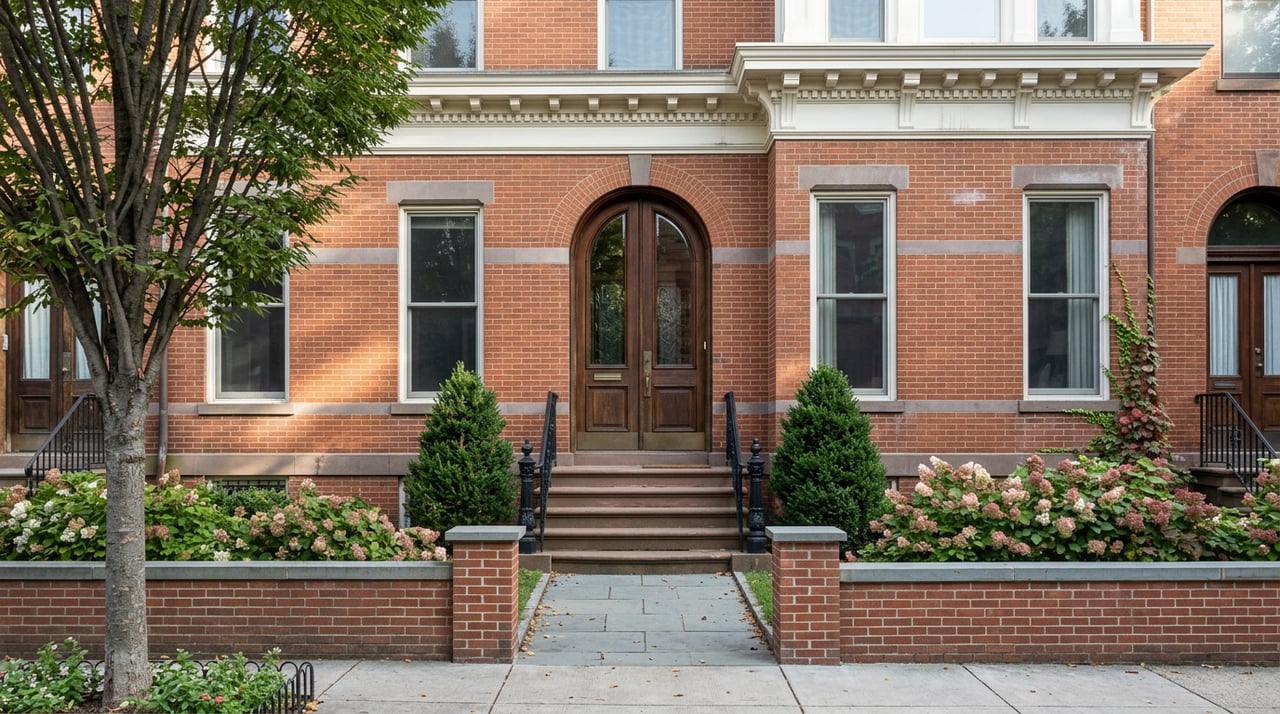
Walk Clinton Hill's blocks and the reason for the volatility becomes visible rather than statistical. This is a neighborhood with real vertical range in its housing stock, not a uniform product that happens to have a few outliers.
The mansion blocks. Clinton and Washington Avenues between DeKalb and Willoughby still hold the Gilded Age houses that gave Clinton Hill its old nickname, Brooklyn's "Gold Coast." Charles Pratt, the oil executive who founded Pratt Institute, built his own mansion at 232 Clinton Avenue in 1874, the same year his company was acquired by Standard Oil, then built three more as wedding gifts for his sons on the same street. Those houses are still there today, part of the Clinton Hill Historic District, which was listed on the National Register of Historic Places in 1985. When one of them sells, the transaction happens in a different conversation entirely: Q1 2026 single-family closings in the submarket hit a median of $4.2 million, up 35 percent year over year, a figure that a handful of high-end sales can move on its own.
The brownstone rowhouses. Below the mansion tier, the market behaves like the rest of Brownstone Brooklyn: low turnover, informed buyers, and pricing that punishes generic comps. These are the Italianate and Beaux-Arts rowhouses that fill out most of the neighborhood's tree-lined blocks.
The co-ops. Many of Clinton Hill's co-op buildings date to earlier conversions and carry pricing that looks nothing like the brownstone tier. PropertyShark's April 2026 figure put the co-op median at $686,000, a fraction of what a mansion-block property or even a rowhouse would command in the same zip code.
The newer condos. Scattered mostly along the neighborhood's edges, these are the smallest and most volume-sensitive category, which is exactly why a single month can produce a 59.5 percent swing in the reported median.
Pratt sits in the middle of all of it
None of this is incidental to the neighborhood's character. Pratt Institute occupies a full city block at Clinton Hill's center, and its public sculpture installations draw people who don't have any other reason to be on campus. The school's founding in 1887 by Charles Pratt is another part of the neighborhood's history; the mansion he built in 1874 predates it, and today the institutional anchor and the priciest housing tier sit at opposite ends of the price spectrum.
The commercial corridors reflect the same layering. DeKalb and Myrtle Avenues carry the daily-life retail, restaurants, coffee shops, wine shops, independent storefronts that survive because people actually live above and around them. Fulton Street to the south connects the neighborhood to the wider Brooklyn grid. Fort Greene Park, with its Sunday farmers market and running loop, sits close enough that Clinton Hill residents treat it as their own backyard, which is part of why data providers frequently fold the two neighborhoods together when talking about the submarket.
The pattern isn't unique to Clinton Hill
If this looked like a Clinton Hill quirk, it would be less useful as a lesson. It isn't. Fort Greene, one street over and inside the same submarket, produced its own version of the same statistical noise in the same season. Only 13 homes sold in Fort Greene in May 2026, a swing that on its own generated a 116.7 percent jump in transaction count year over year and pushed the median sale price to $1.6 million, up 42.1 percent. The condo median in that same report rose 51.2 percent. None of that reflects Fort Greene becoming dramatically more desirable in twelve months. It reflects a small number of closings shifting the mix.
This is the pattern to watch for anywhere in the Fort Greene, Clinton Hill, and Prospect Heights submarket, and probably in any Brooklyn neighborhood where monthly closings run in the dozens rather than the hundreds. A headline percentage change is only as reliable as the sample behind it.
What this means if you're actually comparing neighborhoods
The useful move isn't to find the "correct" median. There isn't one. The useful move is to ask which tier a specific listing belongs to and compare within that tier.
- If you're looking at a mansion-block property on Clinton or Washington Avenue, the relevant comps are the handful of other mansion-block sales, not the neighborhood median.
- If you're looking at a co-op, the $686,000 April 2026 figure is a far more honest starting point than a blended number pulled up toward the mansion tier.
- If you're comparing Clinton Hill to Fort Greene on affordability, do it tier by tier. Clinton Hill's co-op median in April 2026 sat at $686,000, while Fort Greene's co-op median in May 2026 hit $1.3 million, an actual and meaningful affordability gap. The blended neighborhood medians for the same two areas tell a much smaller, less accurate version of that story.
- If you're weighing the current window against last year, note that inventory has moved too. Clinton Hill's asking prices fell 14.2 percent year over year to $1.14 million as of February 2026, while for-sale inventory rose 4.8 percent, conditions that BKReader flagged as tipping the neighborhood toward buyers. That context matters more than any single median.
A few questions worth asking directly
Why did Clinton Hill's median rise and its condo median fall in the same month? Because they're measuring different, much smaller samples. The blended median for April 2026 covered all 20 closings. The condo figure isolated only the condos among them, a small enough number that one or two transactions could produce a headline-grabbing percentage change in either direction.
Is Clinton Hill actually cheaper than Fort Greene? At the aggregate level, generally yes, but the honest comparison happens tier by tier. A co-op buyer will see a much larger gap between the two neighborhoods than a mansion-block buyer will, because the two markets don't move together.
What should I actually do with these numbers when I'm shopping? Ask for transaction-level comps within your specific property type and price tier rather than leaning on the neighborhood-wide median. A rowhouse buyer needs rowhouse comps. A co-op buyer needs co-op comps. The blended number is a headline, not a comp.
Clinton Hill rewards the buyer who understands which conversation they're actually in. If you're weighing this neighborhood against Fort Greene, Prospect Heights, or anywhere else in Brownstone Brooklyn and want the comps that match your specific tier rather than a blended average, Matthew Melinger can walk you through what the numbers actually mean for your search. Schedule a private consultation to get started.